lunes, 29 de febrero de 2016

Session 7 - Evaporation Investigation

Session 7- Evaporation Investigation

Results:
Table 1: Showing the results obtained during the experiment


Graph 1 : Showing the amount of acetone evaporated in mililitres at different increasing temperatures

  • Conclusion


From our results we can conclude that our hypothesis was correct. This is because, as we can see in the table and graph, most of the time, excluding the second column, the one of 25ºC, as the temperature of acetone increases, so will it the evaporation rate.This happens because as the liquid warms and it’s temperature increases, the molecules gain more kinetic energy and will therefore move faster, so they will escape at a faster rate as they gain energy to overcome the IMFs.


  • Evaluation:
We used a fairly accurate method to complete our experiment, although it wasn’t perfect and contained some errors as we can see in the table and the graph( when we heated acetone up to 25ºC the amount evaporated should have been smaller than when acetone was heated up to 35ºC), but the results were precise enough for us to see if our hypothesis was correct.The first thing we should mention is that we started trying the experiment with water, although we realised that water had high boiling point(100ºC) so we wouldn’t have time to do it in two lab sessions as it took very long for water to evaporate. We then decided to do it with ethanol, however it still didn’t evaporate fast enough. Finally, we decided doing the experiment with acetone instead than water as its boiling point is lower(56ºC). We also had to make several modifications in the temperature, we had to increase it to make acetone evaporate faster and making sure that the higher temperature didn’t overcome the boiling point. Furthermore, at first, we were doing the experiment using measuring cylinder as containers. However, the liquid didn’t evaporate at all (*1). Finally, we realised that the liquid needed a larger surface area so we used beakers instead. Our results could have slight errors due to the fact that we decided to put three beakers at a time to have more accurate results and an average, but as the beakers were put in the water bath one after the other, they haven’t been exactly the same amount of time in the water bath.Also, despite we tried to maintain the temperature as accurate as possible, that was impossible as it increased and decreased a few degrees constantly. It wasn’t 25 degrees exactly, but 26 or 27. Besides, when we cleaned the beakers, we cooled them down and this could have affected the results too. Finally, when warming up/cooling down the liquid to 15ºC, as we couldn’t do it with the hot water bath we had to put the beaker in a sink with cold water and ice. This could have varied our results slightly and make them less accurate. Moreover, in order to cool down the water bath quicker, we had to remove some hot water with beakers and then add cold water again. We could have avoided all these temperature problems using a more accurate material and having more time to do the experiment.In addition, when the amount of acetone evaporated was smaller than 1 mL we had to use smaller measuring cylinders in order to measure the results more accurately. 


(*1)

miércoles, 27 de enero de 2016

Session 6 - Job´s method

Session 6 - Job´s method
Stochiometry- Balanced equation
   K2CrO4+BaCl2 --> 2KCl+BaCrO4

Table 1: Showing the results obtained during the experiment


Graph1: Showing the relation between the average height and the volume of BaCl2

Conlcusion:
The graph is consistent with the expected results. The height increases when the volume of BaCl2 is lower than the volume of K2CrO4, then it stays the same when there is equal amount of both substances and finally, the height decreases again as the is more BaCl2 than K2CrO4. The height was the highest when there was the same amount of BaCl2 and K2CrO4. Whe can also see that we must balance the equation K2CrO4+BaCl2 → BaCrO4+KCl by adding a 2 in front of KCl =  K2CrO4+BaCl2 → BaCrO4+2KCl. We need to balance the equation because of the law of conservation of mass: matter can be changed from one form into another, mixtures can be separated or made, and pure substances can be decomposed, but the total amount of mass remains constant. (Chem.wisc.edu, 2016)


Evaluation:
The first thing that could have varied a bit the results and made them less accurate was the fact that when the test tubes came out of the centrifuge, we had to measure the centimetres of solid that were concentrated at the bottom, but the amount wasn’t at the same level, so we had to smoothly hit it against the table, so that it came down and all of it was more or less balanced, but though we did this, it didn’t fully balance, therefore we had to search for a point between the lowest and the highest so that it is as accurate as possible, it wasn’t though, because we can’t know the exact point. We believe this is a random error, because each one of it has a different change in level, which is unpredictable.
A solution we propose for this is to let the test tubes in the same place for a day, so that all of the solid comes down the test tubes and rests on the bottom, just the same that the centrifuge does in less time, but this way we know that everything will be at the same level and that we will be able to measure it accurately.
Another thing that could have varied our results, was the difficulty that caused measuring with such a big pipette, sometimes it wasn’t really accurate  because a few drops were spilled in the process of transporting the solution from the beaker to the test tube. A solution to this is to use a small beaker next time.
It’s very probable we haven’t filled the tube exactly with the amount needed each time, so we have to take into account a parallax error.  Also, the tube was filled by a different member of the group each time, so can be the cause of the mistake.This could have maybe originated a mistake because not all humans have the same view. Maybe, one of  my partners filled more or less the tube than I did and saw the meniscus differently every time, this could be considered as a random error. We could solve this by making sure the tube is filled by the same person every time and to get rid of the parallax error we could be careful and consider the meniscus to make the measuring precise.
Another thing that could have made our result less precise is that we believed the substances that were given to us were really BaCl2 and K2CrO4 but maybe there weren’t as the containers weren’t labelled. If the substances weren’t the ones they were supposed to be, our results will be completely imprecise.  A solution to this is to make sure the containers  containing the substances are labelled.
We should have repeated each individual experiment a few times to reduce random errors.


As we can see, there are lots of things that could be improved for the next time we repeat the experiment by carrying out the solutions we have proposed and receive more accurate results.

References:
 Chem.wisc.edu,. (2016). Retrieved 26 January 2016, from http://www.chem.wisc.edu/deptfiles/genchem/sstutorial/Text1/Tx14/tx14.html


Using the pipette, put 0.5 mL of potassium chromate in the first tube,
1.0 mL in the second, and so on up to the ninth.


Repeat the process filling the tubes with barium chloride making sure that finally each tube has 5 ml in total


Use the centrifuge to settle the solid to the bottom of the test tube.


 Finally, measure the height of the remaining substance and collect all the data in a table


domingo, 6 de diciembre de 2015

Session 4 - Calculating the gas constant, R

Session 4 - Calculating the gas constant, R
Mg+2HCl -> MgCl2+H2

Ideal Gas law: PV=nRT

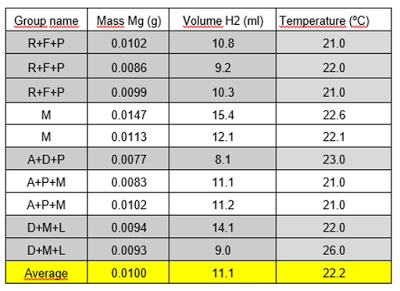
Table 1: Showing the results obtained during the experiment


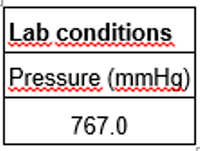
Table 2: Showing the lab conditions

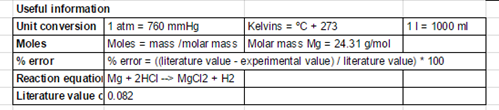
Table 3: Showing useful information needed for the calculations

  • Calculations Explanation

We had to convert all our data so that it came out with the corresponding SI unit. We did this because in order to calculate R (gas constant), we needed to use the Ideal Gas law, in which pressure is measured in atm, volume in L, temperature in K, the gas constant in atm*L/K mol and the number particles in moles.

First of all, we measured the pressure in atm as it is the SI unit for pressure. We knew that the pressure of the room was 767.0 mmHg. We also knew that 1 atm= 760 mmHg. So we transformed it by dividing 767.0/ 760 multiplied by 1. The result was 1.009210526. When we divide, we must maintain the smallest number of significant figures, in this case 4. So, the final result was 1.009 atm.

Secondly, we measured the volume in L as it is the SI unit for pressure. We had it in mL, therefore we’ve got to convert it into L by dividing it by 1000, as 1 L is equal to 1000 mL.
So, as we had 11.1 mL, if we divide it by 1000, it comes out as 0.0111 L. This is because when we are dividing, we must maintain the smallest number of significant figures which in this case is 3.

Then, we measured the water temperature, which SI unit is K (kelvins). The thermometer gave us the temperature in celsius (ºC) so we had to convert it by adding 273: 273+22.2=295.2K. (When adding we must maintain the smallest number of decimal places, in this case 1)


Furthermore, we measured the number of moles of magnesium with the equation: moles= mass(g)/molecular mass(g/mol). We know that we have 0.0100 g of the substance and its molecular mass is of 24.31 g/mol. With this information, we can replace the values we know to find out the number of moles of magnesium like this: 0.0100/24.31= 0.0004113533525 moles. As we know that when we are dividing data from the lab, the result comes out with the less number of significant figures, which in this case is 3, therefore our result will be: 0.000411 moles of magnesium.

Moreover, as we know from studying stoichiometry last year, Mr Canning has given us the reaction equation, and both H2 and Mg have the same coefficient, so we know that they both have the same amount of moles, so therefore there will be 0.000411 moles.

Finally, we replace all of the results we’ve got from the calculations in the Ideal Gas Equation, now that we’ve got all of them with the right measurements (SI units), so that we can calculate our gas constant and compare it to the one it would actually be and calculate the percentage error to deduce some conclusions.

PV=nRT // 1.009·0.0111=0.000411·R·295.2 // 0.0112=0.121·R // R=0.0112/0.121 // R= 0.0923 atm l /K mol. Throughout all the operations we considered the number of significant figures, so finally, as we know that we dividing or multiplying we must maintain the least number of significant figures, which in this case is 3, so it will finally come out as:

R=0.0923 atml/Kmol


  • Conclusion

Considering the Literature value of R is 0.082 the one we obtained ,  0.0923 , is really close to it, although it is slightly bigger than the Literature one and this could have  been originated  by some mistakes we will mention in the Evaluation.
Now, we will calculate the percentage error to see the accuracy of our results:

% error = Experimental Value of R- Literature Value of R
             _______________________________________ *100
                       Literature Value of R                                       


% error = 0.0929- 0.082                % error=  0.0109                
                 ____________  *100//                 _______ *100//  % error=  0.1329268292682927*100//
  
                        0.082                                           0.082                             
       
% error= 13.29268292682927 This will eventually come out as 13%. The percentage error we obtained is low, so this means we didn’t  make lots of mistakes when doing the experiment. Although, Mr. Canning told us the percentage error must be under 10 to consider the experiment totally precise.Even though the results we obtained weren’t perfect, they were clear and precise enough for us to see what  happens during the experiment.

Image showing the reaction between Magnesium and Hydrochloric acid.
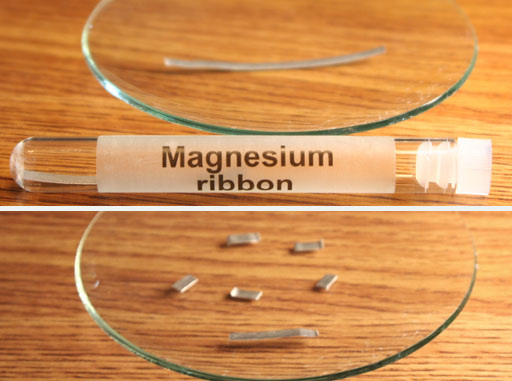


 Image showing pieces of Magnesium used during the experiment.


  • Evaluation:


We used an accurate method to collect the data for this experiment. Although, there could have been several errors that could have spoiled the experiment. Magnesium was exposed to air  so it could have started to react a little bit and could have vary the results. Also, when we weighed it probably it wasn’t pure Magnesium but maybe Magnesium Oxide due to the air. This could have affected the final value of R and made it more inaccurate.This is a random error. We took turns to fill the beaker: The first time it was Ainhoa who filled the beaker and the second time I filled it. This could have maybe originated a mistake because not all humans have the same view, so this is a random error. Maybe, Ainhoa filled it a bit more than I did or vice versa. This could be improved next time by establishing an exact quantity of water to fill the beaker with and making sure the beaker is filled by the same person always. While doing the experiment we assumed that the pressure of the room was equal to the pressure of the tube and this was probably incorrect. This can have caused the value of R we obtained to be incorrect and can be considered a random error. This can be improved by using a small pressure sensor and putting it inside the tube to control the pressure.Probably the temperature of the gas wasn’t the same as the temperature of the water.This is also considered a random error and could be improved by putting a thermometer inside the test tube to control the temperature. An error that could have caused variations in our results was the incorrect calibration of the balance, which is a systematic error. We had to weigh the magnesium several times because we obtained  different weights each time. This could be improved by making sure the balance is well calibrated and by weighing several times the substance used to make sure the weight the balance shows is correct.  Other very common mistake in experiments like this is the incorrect reading of the thermometer or the meniscus. This is called a Systematic Parralax Error. This could be improved by placing  your eye at the level of the appropriate measurement marking when measuring the level of a liquid in a graduated cylinder. Read the lower part of the curved surface of the liquid (the meniscus) to obtain an accurate measurement and avoid parallax errors. It’s also really important to deep the piece of Magnesium in a bit amount of acid for a short period of time to clean and purify it. We didn’t take into consideration that maybe the pieces of Magnesium weren’t the same size and so this could have made our results imprecise, so next time we have to make sure all the pieces of magnesium have the same size. Maybe, we didn’t close well the top of the test tube so a bit of gas escaped while the reaction occurred, next time we should make sure it’s well closed. Another mistake that could have altered our results is that maybe we didn’t pour the distilled water as slowly as we should have done and this could have caused the mix and spread of Hydrochloric Acid. A A thing that is crucial for the results of  an experiment to be reliable is to use new equipment or clean it and dry to avoid substances to mix and vary results. Also, we could have done more tests to get more precise and reliable results as this reduces random errors, but we didn’t have time to do it.
As we can see above, there are lots of things that can be improved for the next time we repeat this experiment and make it more precise.  

domingo, 1 de noviembre de 2015

jueves, 8 de octubre de 2015

The properties of substances and their bonding


Table to show the results obtained in the experiment:


The type of bonding present in each substance:

  • In the first substance there’s an ionic bond. Ionic bonds form hard crystal lattices. They normally have high melting and boiling points and they conduct electricity when they are dissolved in water.
  • The second and third ones are covalent bond. However, the second one is simple and the third one is giant.
  • Simple covalent compounds contain only a few atoms held together by strong covalent bonds.They normally have low melting and boiling points and they don’t conduct electricity.
  • Giant covalent structures contain a lot of non-metal atoms, each joined to nearby atoms by covalent bonds. They have high melting and boiling points and a variable conductivity.
  • The fourth one there’s a metallic bond. Metallic bonds have high boiling and melting points and they are good conductors.


 Table to show the expected results


Conclusion
As we can see in both tables, our results were fairly accurate. If we compare the first and second table we can se that the column of melting points had a few mistakes, as we said that Zinc had a medium melting point and after researching we found ou that it had a high melting point. Also, we said that Magnesium Chloride (Hexahydrate) wasn't soluble in acetone, however, it is fairly soluble. Finally, we also stated that Magnesium Chloride (Hexahydrate) didn't conduct enough electricity when dissolved because tha bulb didn't light up.  After researching some information we discovered that yes, it conducts electricity.
We can see in question 2 that the expectation's table is correct as they match.


Evaluation
The method we used was fairly accurate, our results weren't perfect but they were good enough for us to see what it happens during the experiment. There are lots of things we can improve for the next time we do this experiment. Some of the most important are:
In the first place, the way we were meant to measure the amount of substance we needed (½ spatula)  isn’t accurate as  we can’t get exactly the same half a spatula of each substance as it will always be a bit less or a bit more each time. A solution to this, will be weighing (g) exactly the same amount of each substance, so that the experiment becomes more accurate.


Also, the results of the melting point aren’t accurate either, because we hadn’t heat all the substances for the same time, so this could have originated an error as the time we heated the substances was different every time. We removed the  substance from heat when we thought it had melted or when we saw that it wouldn’t melt. The only thing the instructions in the method said was to wait approximately for 2 minutes as the maximum time(this is for high melting point), but we didn’t know the exact time because we weren’t  using a watch or a stopwatch. We decided if it was medium, low or high by heating the substance and depending on the time it took (lots of time, some time or little time) to start melting, we then decided, but this isn’t accurate. So, as a solution, we could state beforehand a certain timing for each of the boiling points (low, medium or high), for example; low: from 0 to 50 seconds, medium from 51 to 100 seconds and high: from 101 to 150 seconds so that then, when we start heating up the substance, we can see by using a stopwatch the exact time it takes to start melting, and then classify it into one of the boiling points, depending on the time it took for it to start melting.


Furthermore, the way we tried to dissolve the substance in water wasn’t precise because we might have stir it with different forces each time and in different ways and sometimes stirring is not enough. As a solution we could use a machine which mixes the substance with the water, which is much more accurate than what  we did.


Moreover, the light bulb or other components of the circuit, might have been a bit broken or didn't work well enough, so maybe the substance was a conductor but because of this, we wouldn't be able to know. As a solution, we could make sure everything works okay with something we are 100% sure is a conductor before the experiment. There might have also been not enough amount of each substance to light the bulb up, because even though it is a conductor there might have not been  enough of  any of them to light it up, so we could get more of each substance so that there is enough to light a small bulb up.


Finally, each time we lit and turned off the bunsen burner because we wanted to melt something, there wasn’t the exact same amount of heat coming off of it, so this could have originated a problem because maybe some have a higher melting points than others, but because of this, we thought that they had a lowe point. So, this could be solved if you keep it lit up on a corner of the lab so that anyone gets burnt, but it still emits always the same amount of heat.


We could have done more tests to get more precise and reliable results but we didn’t have time to do it. To finish, there is also a thing that could be the cause of a mistake: In our group, we took turns to fill up  the test tube with 5 ml of stirred water or acetone. Maybe one of us, didn't  fill it with exactly 5 ml.  Another thing  that makes our experiment  imprecise is that we used the same volumetric pipet throughout the experiment, so if a bit of stirred water stayed there and mixed with acetone or vice versa it could have make our results to vary. A solution to this is to take a different volumetric pipet each time or if there are not enough, clean it and dry it before using it again.


Bibliography

  • Bbc.co.uk,. (2015). BBC - GCSE Bitesize: Covalent bonding - giant covalent structures. Retrieved 9 October 2015, from http://www.bbc.co.uk/schools/gcsebitesize/science/add_aqa_pre_2011/atomic/differentsubrev3.shtml

  • Bbc.co.uk,. (2015). BBC - GCSE Bitesize: Metal properties and uses. Retrieved 9 October 2015, from http://www.bbc.co.uk/schools/gcsebitesize/science/add_ocr_pre_2011/chemicals/metalpropertiesrev1.shtml

  • Deshpande, A. (2015). Properties of GraphiteBuzzle. Retrieved 9 October 2015, from http://www.buzzle.com/articles/graphite-properties.html

  • Npi.gov.au,. (2015). Zinc and compounds | National Pollutant Inventory. Retrieved 9 October 2015, from http://www.npi.gov.au/resource/zinc-and-compounds

  • Scbt.com,. (2015). Magnesium Chloride, Hexahydrate | CAS 7791-18-6 | Santa Cruz Biotech. Retrieved 9 October 2015, from http://www.scbt.com/datasheet-203126-magnesium-chloride-hexahydrate.html